This morning I was reading Jack Kornfield's A Path With Heart, and the topic concerned compassion, co-dependency, boundaries and self-esteem.
It seemed appropriate, given yesterday's belated post about learning to say no, and so I took those thoughts with me on my walk -- thoughts about being compassionate with ourselves; about giving, not out of fear, but out of abundance; about being honest with ourselves about what we need.
And as I walked this little refrain began to accompany my steps:
I can only be what I can be;
I can only do what I can do;
I can only give what I can give --
Life's not what it's not;
It is what it is.
But then I kept thinking about what I learned in my courses last term, about what happens when you put two or more people together in an open and safe space, and how the sum of what happens there is greater than the sum of the parts: it's a bit like that passage in Matthew 18:20 -- "Where two or three are gathered in my name, there am I also." If you conflate those two concepts, then God becomes the energy that flows between us -- or perhaps it's that the energy that flows between us becomes Divine?
At any rate, the refrain went through some evolutions, and became this:
What we can be;
What we can do;
What we can give --
Is so much more
When we can be and do and give together.
So then I came back and found this image: a perfect pristine canoe, suspended above the water, completely apart from the world. But the canoe wasn't born to hang there; it was created to be in the water, to balance, to move forward, to ride the waves.
Though time for rest, retreat, and renewal is important to achieve the self awareness that can fuel us for the journey, it's not enough to perfect ourselves apart from our communities. Humans are primarily social animals, and at some point we need to engage, to get back into the fray and paddle as best we can. We can be all about looking good and seeming together, but the real test is this: can we stay afloat when we get back into the water; when we begin again to do and be and give what life asks of us?
Artist/poet Diane Walker invites you to return to your compassionate and peaceful center
Thursday, September 30, 2010
Wednesday, September 29, 2010
Time to stop and breathe
You know how we all used to dream that a knight on a white horse would come and rescue us -- you know, back when we thought of ourselves as fragile and helpless...
I think this image -- with its tired old horse -- sang to me this evening because I've been struggling for the last several hours trying to get a document to print out of InDesign in the same colors I see on my screen.
It took me a while, but I got Photoshop to print right after I got my new computer. And they're part of the same software suite, right? So InDesign should print right as well, right?
Not so -- at least not so far, although I had a small stroke of genius about 5 minutes ago and tried printing a photoshop document and matching all the settings between the two print dialogs (and wouldn't you think they could STANDARDIZE that dialog box?). Ooh, here it comes, let's check... NO! The red box is still printing as yellow. GRRR.
I wish I could just call some knight to come in and fix all the settings for me. But the thought of an extended dialog with someone on the other side of the world who assumes I am completely clueless and answers questions I wasn't asking in the first place is just not all that appealing. The truth is, I just have to keep fiddling -- and using up this expensive paper -- until I can get it to work. Which is not how I wanted to spend my time today -- I'm doing this project as a favor for a friend, you know the kind, "Oh, just take a couple of pictures and run it off again, no problem."
It's a great lesson I seem to have forgotten somewhere along the way: learn to say NO! But it's also frustrating that something that printed beautifully on my old computer 2 years ago is such a disaster on my new one. And at some point I WILL need to solve this problem. I just kind of didn't want to deal with it NOW.
So -- as my husband would say -- What did you learn from this?
I think maybe I thought _I_ was the knight on the white horse. Maybe it's just time to put me out to pasture? Nope. I think I just need to pull an Einstein: take a break, take a nap, come back fresh and the solution will be obvious -- I've just put in too many hours today; I'm forgetting to stop and breathe.
How about you? Did you stop and breathe today?
I think this image -- with its tired old horse -- sang to me this evening because I've been struggling for the last several hours trying to get a document to print out of InDesign in the same colors I see on my screen.
It took me a while, but I got Photoshop to print right after I got my new computer. And they're part of the same software suite, right? So InDesign should print right as well, right?
Not so -- at least not so far, although I had a small stroke of genius about 5 minutes ago and tried printing a photoshop document and matching all the settings between the two print dialogs (and wouldn't you think they could STANDARDIZE that dialog box?). Ooh, here it comes, let's check... NO! The red box is still printing as yellow. GRRR.
I wish I could just call some knight to come in and fix all the settings for me. But the thought of an extended dialog with someone on the other side of the world who assumes I am completely clueless and answers questions I wasn't asking in the first place is just not all that appealing. The truth is, I just have to keep fiddling -- and using up this expensive paper -- until I can get it to work. Which is not how I wanted to spend my time today -- I'm doing this project as a favor for a friend, you know the kind, "Oh, just take a couple of pictures and run it off again, no problem."
It's a great lesson I seem to have forgotten somewhere along the way: learn to say NO! But it's also frustrating that something that printed beautifully on my old computer 2 years ago is such a disaster on my new one. And at some point I WILL need to solve this problem. I just kind of didn't want to deal with it NOW.
So -- as my husband would say -- What did you learn from this?
I think maybe I thought _I_ was the knight on the white horse. Maybe it's just time to put me out to pasture? Nope. I think I just need to pull an Einstein: take a break, take a nap, come back fresh and the solution will be obvious -- I've just put in too many hours today; I'm forgetting to stop and breathe.
How about you? Did you stop and breathe today?
Tuesday, September 28, 2010
The blocks that make us whole
"As our development of self grows and our heart becomes less entangled, we begin to discover a deeper truth about the self: We do not have to improve ourselves; we just have to let go of what blocks our heart. When our heart is free from the contractions of fear, anger, grasping, and confusion, the spiritual qualities we have tried to cultivate manifest in us naturally. They are our true nature, and they spontaneously shine in our consciousness whenever we let go of the rigid structures of our identity."
-- Jack Kornfield, A Path With Heart
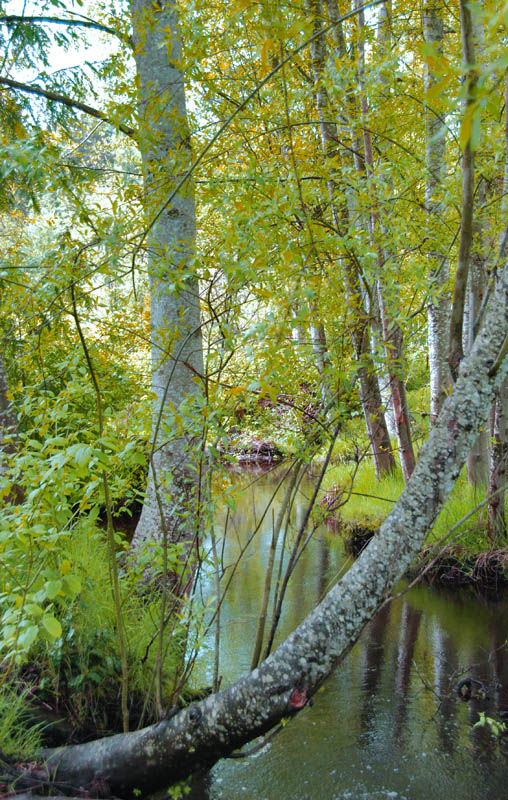
I find this passage -- and Kornfield's absolute conviction that the True Self that lies beneath is a beautiful, whole and godly thing -- enormously reassuring. So when this image jumped out at me today, I decided that that tree that loops across the foreground and blocks your view of the stream represents "what blocks our heart."
But what interests me is that, although that foreground tree (and the little wounded spot on its trunk) keeps the picture from a conventional prettiness, it also adds artistic value of its own to the image, and pulls us into the picture in the very act of blocking our vision.
Which tells me that even though I've found some brief respite by stepping back into A Path With Heart, the messages I've been gathering in earlier posts this week about loving opposites, and about attraction and aversion, are still floating around in my consciousness. So you have to ask: just how is it that we let go of what blocks our hearts? And again, I think the answer lies in learning to love all the parts of ourselves and our circumstances -- and most especially those things that block us, and in the blocking force us to look beyond to what lies beneath.
Because the blocks -- however irritating they may be -- could be exactly what defines us, what gives us depth and life and originality. I suspect it may be true that it is only when we can learn to see the gifts in those blocks that we can fully realize the joyous spirits we were born to be; the True Self and all its unique blessings.
-- Jack Kornfield, A Path With Heart
I find this passage -- and Kornfield's absolute conviction that the True Self that lies beneath is a beautiful, whole and godly thing -- enormously reassuring. So when this image jumped out at me today, I decided that that tree that loops across the foreground and blocks your view of the stream represents "what blocks our heart."
But what interests me is that, although that foreground tree (and the little wounded spot on its trunk) keeps the picture from a conventional prettiness, it also adds artistic value of its own to the image, and pulls us into the picture in the very act of blocking our vision.
Which tells me that even though I've found some brief respite by stepping back into A Path With Heart, the messages I've been gathering in earlier posts this week about loving opposites, and about attraction and aversion, are still floating around in my consciousness. So you have to ask: just how is it that we let go of what blocks our hearts? And again, I think the answer lies in learning to love all the parts of ourselves and our circumstances -- and most especially those things that block us, and in the blocking force us to look beyond to what lies beneath.
Because the blocks -- however irritating they may be -- could be exactly what defines us, what gives us depth and life and originality. I suspect it may be true that it is only when we can learn to see the gifts in those blocks that we can fully realize the joyous spirits we were born to be; the True Self and all its unique blessings.
Monday, September 27, 2010
High Hopes
We watched with amusement yesterday as our outdoor cat, Alex, carefully stalked this heron, who had decided to groom himself on one of our logs. Herons are notoriously skittish, so, of course, as soon as Alex reached the end of that ramp the heron flapped his great wide wings and took off, squawking all the way in indignation.
We have to assume that it was all a game for Alex; surely he knows the heron is too big for him! But it makes me think of that song that was popular when I was a kid, High Hopes:
Once there was a silly ol' ram,
Thought he'd punch a hole in a dam;
No one could make that ram, scram,
He kept buttin' that dam
But he's got high hopes... he's got high hopes
He's got high apple pie in the sky hopes
So any time you're feeling bad
'Stead of feeling sad
Just remember that ram.
Oops there goes a billion kilowatt
Oops there goes a billion kilowatt dam!
Reading of Mary Magdalene again this morning, I feel about as foolish as my cat: the esoteric ideals and imaginal worlds Bourgeault (and Mary) are describing seem as remote and impossible as the heron, and have an amazing gift for flying off out of reach just when I think I'm getting close.
But there are bits here and there which I find encouraging -- or at least comprehensible -- and the phrase that caught me this morning was this: "It is the chains of attraction and aversion, forged in the dominion of wrath, that bind us solidly to the gravitational field of this world."
This feels like another way in to the tension of opposites I was speaking of yesterday. As long as we continue judging -- "This is okay, this is not okay. This is good, this is bad. She is nice, he is not nice. Your behavior is despicable, mine is not. These people/clothes/activities/neighborhoods/politicians are admirable/attractive/desirable/worthy and those are not." -- we are dividing the world and ignoring its underlying unity.
So I get that. But what I can't see is how it could be possible to function without judging. Now perhaps it's because I am, on the Myers-Briggs scale, an ENFJ, which means judging, making decisions, choosing, comes relatively easy for me. And I know from watching family members who do NOT have that J at the end of their profiles that it's a bit trickier getting on in the world without that capacity. It turns out to be surprisingly useful to be able to quickly assess "That works for me, this doesn't." Not only does it speed up shopping trips (!) but it also serves as a useful protective device -- I see warning signs in situations or people, and "just don't go there," which can save me lots of grief.
But isn't that exactly it -- if you're good at navigating this earthly life, aren't those exactly the skills that keep us rooted here and make it hard to imagine another way of being? And couldn't it be true that the things I protect myself from might be the very things that could help give me a push toward a deeper understanding of oneness?
Ah-- but in looking at it that way, I'm judging again: this behavior works here, but fails there. See how pervasive this tendency can be?
And so I think I will continue to emulate my cat: I will creep slowly -- very very slowly -- toward my goal, holding as steady as I can, knowing the high probability that just when I get within reach it will fly away -- again. Because in that slow creeping I am learning balance, and focus; in keeping my eyes on the prize, I am finding a steadiness of purpose. In working to escape those chains of attraction and aversion, and in tempering the wrath I feel when things don't go my way, I can begin to at least imagine another way of being in the world.
And it's all good.
We have to assume that it was all a game for Alex; surely he knows the heron is too big for him! But it makes me think of that song that was popular when I was a kid, High Hopes:
Once there was a silly ol' ram,
Thought he'd punch a hole in a dam;
No one could make that ram, scram,
He kept buttin' that dam
But he's got high hopes... he's got high hopes
He's got high apple pie in the sky hopes
So any time you're feeling bad
'Stead of feeling sad
Just remember that ram.
Oops there goes a billion kilowatt
Oops there goes a billion kilowatt dam!
Reading of Mary Magdalene again this morning, I feel about as foolish as my cat: the esoteric ideals and imaginal worlds Bourgeault (and Mary) are describing seem as remote and impossible as the heron, and have an amazing gift for flying off out of reach just when I think I'm getting close.
But there are bits here and there which I find encouraging -- or at least comprehensible -- and the phrase that caught me this morning was this: "It is the chains of attraction and aversion, forged in the dominion of wrath, that bind us solidly to the gravitational field of this world."
This feels like another way in to the tension of opposites I was speaking of yesterday. As long as we continue judging -- "This is okay, this is not okay. This is good, this is bad. She is nice, he is not nice. Your behavior is despicable, mine is not. These people/clothes/activities/neighborhoods/politicians are admirable/attractive/desirable/worthy and those are not." -- we are dividing the world and ignoring its underlying unity.
So I get that. But what I can't see is how it could be possible to function without judging. Now perhaps it's because I am, on the Myers-Briggs scale, an ENFJ, which means judging, making decisions, choosing, comes relatively easy for me. And I know from watching family members who do NOT have that J at the end of their profiles that it's a bit trickier getting on in the world without that capacity. It turns out to be surprisingly useful to be able to quickly assess "That works for me, this doesn't." Not only does it speed up shopping trips (!) but it also serves as a useful protective device -- I see warning signs in situations or people, and "just don't go there," which can save me lots of grief.
But isn't that exactly it -- if you're good at navigating this earthly life, aren't those exactly the skills that keep us rooted here and make it hard to imagine another way of being? And couldn't it be true that the things I protect myself from might be the very things that could help give me a push toward a deeper understanding of oneness?
Ah-- but in looking at it that way, I'm judging again: this behavior works here, but fails there. See how pervasive this tendency can be?
And so I think I will continue to emulate my cat: I will creep slowly -- very very slowly -- toward my goal, holding as steady as I can, knowing the high probability that just when I get within reach it will fly away -- again. Because in that slow creeping I am learning balance, and focus; in keeping my eyes on the prize, I am finding a steadiness of purpose. In working to escape those chains of attraction and aversion, and in tempering the wrath I feel when things don't go my way, I can begin to at least imagine another way of being in the world.
And it's all good.
Sunday, September 26, 2010
On the integration of opposites
Last night we went to our fourth and last birthday celebration of the week. Wednesday's was for my husband, Thursday's was for our older daughter's almost-fiancee, Friday's was for our younger daughter, and yesterday's was the 20th birthday celebration for the wonderful church we helped to found on Seattle's eastside: Good Samaritan Episcopal Church in Sammamish, Washington.
The evening was also a celebration of the ministry of Pastor Fred Jessett, shown here with his wife Kris at our younger daughter's belated baptism. Fred knocked on over 1200 doors in his efforts to get Good Sam off the ground, and though he's now long-retired, he still serves as vicar emeritus for his adoring congregation.
Due to a last minute seating change, I found myself sitting beside Good Sam's brand new music director, and -- as happens sometimes -- we slipped almost immediately into a deeper level of conversation than usually attends such social events; clearly, at some level, we were kindred spirits.
But afterward, as often happens, I found I was kicking myself a bit for having monopolized the conversation. And my first thought was, "Shoot -- I went off into Chatty Cathy mode again!"
But then I read, in Cynthia Bourgeault's The Meaning of Mary Magdalene, that when Mary talks about the importance of becoming "fully human," she's using the word anthropos, which refers -- as does Logion 22 in the Gospel of Thomas, to "an integration of the opposites within oneself... the union of the finite and infinite within oneself... so that that there is "one Heart, one Being, one Will, one God, all in all."
This passage seemed to echo some of the conclusions of the final term paper I wrote while in Vermont last week: I had written that in order to serve others we need to be conscious of our own motivations, blind spots and weaknesses. "Awareness and acceptance of my strengths and weaknesses," I had written, "empowers me to become – whatever I do -- a more balanced and integrated whole."
So I began looking back over the evening and that conversation with different, less hostile eyes, in hopes of finding a way to love behaviors I often find distasteful. And what I saw was that it was cruel to call myself "Chatty Cathy" and crueler still to assume I was attempting to impress my new friend. I suspect, instead, that what drove the conversation was a sort of youthful eagerness, a desire to share strategies that might protect the person from some of the hardships I'd endured; to offer a sort of jumpstart along the path to wholeness.
And suddenly I could picture my older daughter, so painfully bright, so eager to share her knowledge with new friends, and so frequently rejected for those behaviors because they weren't ready to hear, or thought she was hopelessly nerdy. And isn't that really the story of Christ -- desperately trying to help his disciples understand the nature of that mystical union, and being first misunderstood and then ultimately crucified for his efforts?
There's an exercise I've mentioned here before, that I learned a few years back in a workshop given by a Parker-Palmer-inspired group called Washington Courage and Renewal: write down the characteristics in yourself that you find hardest to love, and figure out the gifts those characteristics bring to you and the world. The answers surprised me then, and continue to bless me today. So I heartily suggest -- next time you hear those voices inside you, attacking repeat behaviors -- that you spend some time getting to know and love both those voices and those behaviors. I feel certain they have lessons to teach us, and I firmly believe that if we can integrate them into our total being we'll find it easier to grow into the fully human individuals we were born to become.
The evening was also a celebration of the ministry of Pastor Fred Jessett, shown here with his wife Kris at our younger daughter's belated baptism. Fred knocked on over 1200 doors in his efforts to get Good Sam off the ground, and though he's now long-retired, he still serves as vicar emeritus for his adoring congregation.
Due to a last minute seating change, I found myself sitting beside Good Sam's brand new music director, and -- as happens sometimes -- we slipped almost immediately into a deeper level of conversation than usually attends such social events; clearly, at some level, we were kindred spirits.
But afterward, as often happens, I found I was kicking myself a bit for having monopolized the conversation. And my first thought was, "Shoot -- I went off into Chatty Cathy mode again!"
But then I read, in Cynthia Bourgeault's The Meaning of Mary Magdalene, that when Mary talks about the importance of becoming "fully human," she's using the word anthropos, which refers -- as does Logion 22 in the Gospel of Thomas, to "an integration of the opposites within oneself... the union of the finite and infinite within oneself... so that that there is "one Heart, one Being, one Will, one God, all in all."
This passage seemed to echo some of the conclusions of the final term paper I wrote while in Vermont last week: I had written that in order to serve others we need to be conscious of our own motivations, blind spots and weaknesses. "Awareness and acceptance of my strengths and weaknesses," I had written, "empowers me to become – whatever I do -- a more balanced and integrated whole."
So I began looking back over the evening and that conversation with different, less hostile eyes, in hopes of finding a way to love behaviors I often find distasteful. And what I saw was that it was cruel to call myself "Chatty Cathy" and crueler still to assume I was attempting to impress my new friend. I suspect, instead, that what drove the conversation was a sort of youthful eagerness, a desire to share strategies that might protect the person from some of the hardships I'd endured; to offer a sort of jumpstart along the path to wholeness.
And suddenly I could picture my older daughter, so painfully bright, so eager to share her knowledge with new friends, and so frequently rejected for those behaviors because they weren't ready to hear, or thought she was hopelessly nerdy. And isn't that really the story of Christ -- desperately trying to help his disciples understand the nature of that mystical union, and being first misunderstood and then ultimately crucified for his efforts?
There's an exercise I've mentioned here before, that I learned a few years back in a workshop given by a Parker-Palmer-inspired group called Washington Courage and Renewal: write down the characteristics in yourself that you find hardest to love, and figure out the gifts those characteristics bring to you and the world. The answers surprised me then, and continue to bless me today. So I heartily suggest -- next time you hear those voices inside you, attacking repeat behaviors -- that you spend some time getting to know and love both those voices and those behaviors. I feel certain they have lessons to teach us, and I firmly believe that if we can integrate them into our total being we'll find it easier to grow into the fully human individuals we were born to become.
Saturday, September 25, 2010
Gradual, conscious and sober
"Jesus... did not change anyone's states, either by secret rituals or by esoteric information. Rather he set his disciples on the only known path to integral transformation: the slow and persistent overcoming of the ego through a lifelong practice of surrender and non-attachment. His gnosis is gradual, conscious, and sober."
--Cynthia Bourgeault, in The Meaning of Mary Magdalene
A young friend of our daughter's came to stay with us for a couple of weeks this summer, and last night she and her father came back to the island to take us out to dinner as a thank you for having hosted her while she decided about applying to the University of Washington.
Unfortunately the evening began and ended awkwardly: their ferry was an hour late, and we forgot to watch the clock at the end of the evening so they missed the 9:45 and had to wait until after 11 to get back to Seattle.
I woke up this morning with that queasy feeling in my stomach that always comes with a sense of guilt: why had I not been more conscious of the time? How could I have subjected our guests to such thoughtless behavior?
Oddly enough, I found the above-quoted passage enormously reassuring. For some reason, what I hear when I read it is that it's okay that I am not yet perfect (perhaps this is the true nature of forgiveness?). It's okay that I am not yet always fully conscious. The process of integration is predictably gradual, and "a slow and persistent overcoming of the ego" is all that is required of me. It's okay to fail from time to time, and inevitable -- as the barriers between self and other begin dissolving -- that the ways I fail others will echo all that more loudly in the chambers of my heart as my capacity for compassion continues to grow.
I think this image rose up for me because it reflects that philosophy: not every day will be sunny, nor will the garden that is my life always be tidy. But there is beauty to be found even in the fog of confusion and the weeds of neglect, as long as that which we hope to tend in ourselves and others is still growing. Perhaps today what I need to surrender is my need to do it right, and it's time to release my attachment to perfection...
--Cynthia Bourgeault, in The Meaning of Mary Magdalene
A young friend of our daughter's came to stay with us for a couple of weeks this summer, and last night she and her father came back to the island to take us out to dinner as a thank you for having hosted her while she decided about applying to the University of Washington.
Unfortunately the evening began and ended awkwardly: their ferry was an hour late, and we forgot to watch the clock at the end of the evening so they missed the 9:45 and had to wait until after 11 to get back to Seattle.
I woke up this morning with that queasy feeling in my stomach that always comes with a sense of guilt: why had I not been more conscious of the time? How could I have subjected our guests to such thoughtless behavior?
Oddly enough, I found the above-quoted passage enormously reassuring. For some reason, what I hear when I read it is that it's okay that I am not yet perfect (perhaps this is the true nature of forgiveness?). It's okay that I am not yet always fully conscious. The process of integration is predictably gradual, and "a slow and persistent overcoming of the ego" is all that is required of me. It's okay to fail from time to time, and inevitable -- as the barriers between self and other begin dissolving -- that the ways I fail others will echo all that more loudly in the chambers of my heart as my capacity for compassion continues to grow.
I think this image rose up for me because it reflects that philosophy: not every day will be sunny, nor will the garden that is my life always be tidy. But there is beauty to be found even in the fog of confusion and the weeds of neglect, as long as that which we hope to tend in ourselves and others is still growing. Perhaps today what I need to surrender is my need to do it right, and it's time to release my attachment to perfection...
Friday, September 24, 2010
Focus on the blues
Today is my younger daughter's birthday; she came over from Seattle to have lunch with us (and open presents of course!) but will be returning to the city for this evening's partying activities.
It's fun to watch her leap into her new life, but she's not exactly a still pond: life's a bit crazy right now. So when I found this photo I had taken my last afternoon in Vermont I found myself responding intensely to the stillness of it, and to those rich, deep, calming blues.
... which makes me wonder: can the blues -- I mean the kind of blues that make you sing sad songs about "Dat man who done me wrong" -- also be calming? How did the color blue come to be associated with sadness? It seems odd to me, because blue, for me, is associated with sunny skies.
Ah well. That's about as deep a question as I can ask when she's bustling around getting ready to move another pile of stuff to her new apartment. To muse on the really deep stuff of life, you need a little peace and quiet -- or, at least _I_ do -- and that seems to be in short supply at the moment. Which means I need to grab those calming breaths in odd moments, and trust that they, and images like this one, will be enough to tide me over to my next opportunity for peace.
May this photo offer you -- if only momentarily -- a spot of tranquility in your busy day...
It's fun to watch her leap into her new life, but she's not exactly a still pond: life's a bit crazy right now. So when I found this photo I had taken my last afternoon in Vermont I found myself responding intensely to the stillness of it, and to those rich, deep, calming blues.
... which makes me wonder: can the blues -- I mean the kind of blues that make you sing sad songs about "Dat man who done me wrong" -- also be calming? How did the color blue come to be associated with sadness? It seems odd to me, because blue, for me, is associated with sunny skies.
Ah well. That's about as deep a question as I can ask when she's bustling around getting ready to move another pile of stuff to her new apartment. To muse on the really deep stuff of life, you need a little peace and quiet -- or, at least _I_ do -- and that seems to be in short supply at the moment. Which means I need to grab those calming breaths in odd moments, and trust that they, and images like this one, will be enough to tide me over to my next opportunity for peace.
May this photo offer you -- if only momentarily -- a spot of tranquility in your busy day...
Subscribe to:
Posts (Atom)