Tuesday, February 8, 2011

Risking the storms

Doesn't this look like an incredibly idyllic retreat?  I know nothing about it; just spotted it while photographing some nearby boats.  But to me it looks like the stuff of dreams...

But I wonder how the people who live there feel about it.  Do they grow immune to the pleasure and beauty of it over time?  Do they get to spend much time there?  Is it a vacation home, or a full-time residence?  I imagine the pleasure of falling asleep listening to the waves beneath the cabin.  But what would it be like in a storm?  Is this cove reasonably sheltered, or do they regularly get buffeted by fierce winds?

Or, maybe, to put it in more personal terms: if this house were for sale, at a reasonable price, and I were looking for a home, would I be tempted to purchase it?  Or would I look for a safe place, away from the wind and waves?  Because it looks to me like this house would be both more fun and more scary to live in than the average suburban residence.

I am reading this morning about gratitude, both in the Spirituality and Practice website's course on Interspiritual Meditation and in Brene Brown's book, The Gifts of Imperfection.  And they both point out that gratitude is more of a practice than an attitude: we need to be consciously thankful for the gifts in our lives.  And those gifts include, not just the peaceful mornings like this one, but the stormy ones as well.  Because the storms -- and the fear and anxiety that accompany them -- have their own gifts to bring us.

And here's one of the most important things Brown has to tell us about that: if we attempt to numb ourselves -- whether through drugs, or alcohol, or excessive use of the internet, or overwork, or shopping, or eating -- so that we don't feel the impact of those storms, then that numbing also makes us immune to the joys and pleasures at the other end of the spectrum.  Which in turn deprives us of the sustenance we need to get through the next storm. 

If we open ourselves to feelings at one end of the spectrum -- the emotional equivalent of buying the house on the water -- then we open ourselves to the storms as well.  But if we close ourselves to the storms -- the emotional equivalent of buying the safe house -- then we cut ourselves off from the pleasures of life as well.

We have to be willing to feel, not just the good stuff, but the bad stuff, too.  And it seems clear that if we make a practice of gratitude -- of noticing, and being thankful for, both the blessings and the challenges of life -- life will prove to be a much richer and more colorful experience. 

Monday, February 7, 2011

Trumpeting our stories

After such a full weekend -- class all day Friday, the Book Festival Saturday, long conversations on Sunday -- I feel like my head is exploding with stories.  Certainly the initial minutes of my meditation time were spent sifting through all the stories; it seemed to take forever to get back down into that quiet space within that feeds me.

And it seems to me that that was one of the key learnings of the weekend -- this weekend of storytelling and sharing: that however strong the urge may be to trumpet our stories, the truth is that we are NOT our stories; that in fact story gets in the way of knowing, of presence, of wonder and awe, of connection...

Yes, a tiny piece of story can build that first bridge -- like the wonderful connection I felt with Rose, a woman from Australia who was in town to hear her sister's presentation.  It was fun to hear we'd grown up not far apart, in small towns in Ohio; fun to hear she lived not far from my niece in Australia; moving to hear that she, too, had recently spent time at the deathbed of a dear one.  But the connection came not in the details of the stories but in the sharing of responses, and feelings.  We only spoke briefly, over lunch.  But I felt a wonderful bond with her, and still treasure the sense of affinity we shared across the table.

I felt that again, listening to Anne Lamott.  Her speech was marvelous: she peppers her talks, as she seasons her books, with references to incredibly juicy stories.  But it is not the story that builds the connection you can't help feeling with her: it's the emotions, the revelations, the responses, the discoveries that emerge; the vulnerability she shares, and the hope she reveals, that make her such a joy to listen to and read.

At some point in her talk, Lamott shared something she'd heard that she thought might challenge us.  "The opposite of faith isn't doubt," she said.  "It's certainty."  But my husband (who was amazingly wise this weekend) said later, driving home, that he thought that observation was a little off.  "I think what really happens" he said, "is that faith begins where certainty ends."

Thinking about that now, I'm thinking that stories are often about certainty.  This thing happened to me.  This is my reality.  I'm certain I was victimized, or betrayed, or damaged by this (so often that's the root of our stories).  And I think he's right.  Faith is that sense of mystery and wonder that comes in when you realize you can no longer be certain (maybe even certain that someone else is at fault, or that you were at fault, or that fault and blame even matter).  It's the piece that lies below the story, the breath that stops when you get past the words, the mysterious sense of connection you feel when all the masks and pronouncements and language we use to declare ourselves to the world fall away and the vulnerability beneath lies revealed.

Which of course makes me stop in my tracks -- I am, after all, an inveterate storyteller.  That's what this blog is about.  But it comes back to the balance I mentioned in last night's post.  There needs to be a balance between story and wonder.  Story alone won't get us there: we need to step into the silence that follows the story; to stop and sense that which lies beneath.

Sunday, February 6, 2011

A striking balance

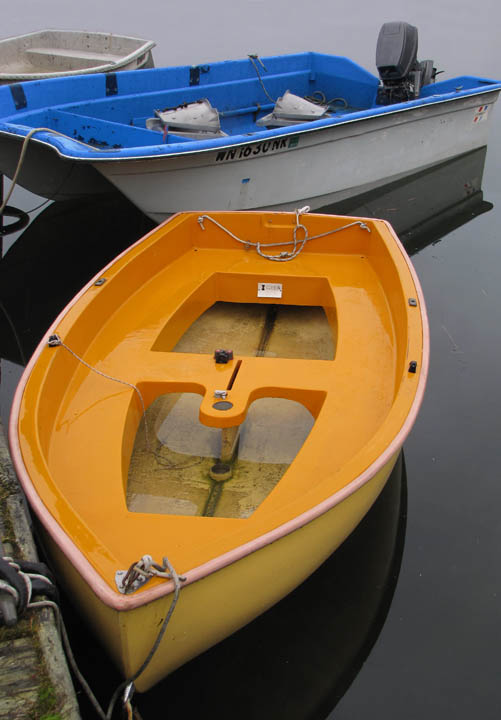
Don't you just love these colors?  Even though these are just plastic boats (I usually prefer to photograph old wooden dinghies) I thought they were just beautiful together.

And part of the reason is that blue and orange are opposites on the color wheel (like green and red, and purple and yellow).  Which means if you were to mix them together, you'd get this ugly brown color.  But when you put them side by side, they just pop.  Which is a good thing!

Which makes me think about a conversation we had at dinner tonight, about the importance of balance.  Initially we were talking about hi-tech corporations, and how they need a balance of sales and engineering to function well.  And then we thought, well, humans need a balance of right and left brain functions. 

And then I thought, well, marriage needs a balance, too -- and certainly mine (in which we are opposites in lots of ways) seems more stable as a result of that.  But we kind of need to stand a bit separate, be who we are, not blend into one another, because maybe things get a little muddy when we get too interdependent.  At the same time, what keeps us together is common values, shared experiences, and a sense that both of us are committed to something larger than ourselves.

And what does that say about our two-party system, or the imbalance between rich and poor?  Isn't it possible we need all these different ways of looking and being in the world to achieve a balanced picture?  And maybe it's not important that we all agree on all the issues -- because surely in such a case something important might get overlooked.  Perhaps it's only necessary for us to find some common ground -- or water -- in which we can float together; some shared commitment to something larger than ourselves...

Saturday, February 5, 2011

Instead of judging...

Have you met Gladys yet?

I bought Gladys last summer on Ebay, when I was creating that deck chair for the lawn chair exhibit.  I photographed her on a webbed chair, in the grass, and then printed the photo on canvas and suspended it in one of those old-fashioned deck chairs...

Anyway, the thing with full-size mannequins is, they take up space -- wherever they stand.  So Gladys has been living in a little-used corner of our living room since her deck chair debut.  And when winter came we decided to dress her in warmer clothes.

But we've grown used to her -- we don't really notice she's there -- so we're always a little surprised when new people come into the house and sort of reel back in shock.  I mean, well -- she's Gladys.  She's part of the family now.  She belongs.

But I found this photo today and decided to put it up (warning, this is not one of my usual morning blog posts, just something I heard that I wanted to pass on) because we were driving home from my talk at Seattle U (yes, it went WONDERFULLY: Thanks for all your thoughts and prayers) and we were remarking on one of the lectures we heard, noticing that we'd both projected negative thoughts onto the speaker until she spoke, and I just had to share this comment I heard from one of the students in my metaphor class at Antioch yesterday. 

It was Joey, a young man from Jersey, handsome, athletic, with a big booming voice that reminds me SO much of my Uncle Bob (also from Jersey) that I always have to smile when he talks.  And Joey said this -- I could hear him way on the other side of the room during one of our breakout sessions --  "You just have to ask: 'What is it about that person that I just don't like in me?' "

Isn't that a great line?

So if I look at Gladys -- or anyone else for that matter -- really look at her, and think, hmm, not sure I like that about her, it's a pretty good bet that what's putting me off is something I don't like in ME.

Yeah, I know, you've heard it all before.  But this is just a reminder -- having just made that mistake AGAIN -- that you should maybe be wary when your mind starts judging.

And here's the best part.  I told my husband this story, and he said, "Well, you know what I say: I just assume everyone I talk to is God."

"No,"I replied, "you never told me that."

"Oh," he said, "I just thought you knew.  It's kind of like that line from the Bible -- you know, doing it to the least of these is doing it to me?  I just think, this guy could be God; could be he's having a bad day, or testing me or something."

Wow.  No wonder I'm still married to this man after all these years...

Thursday, February 3, 2011

Fitting in is not belonging

This morning, in Brene Brown's wonderful little book,  The Gifts of Imperfection, I am reading about the importance of belonging.

"Most of us use the terms fitting in and belonging interchangeably, and like many of you, I'm really good at fitting in.  We know exactly how to hustle for approval and acceptance.  We know what to wear, what to talk about, how to make people happy, what not to mention -- we know how to chameleon our way through the day.

One of the biggest surprises in this research was learning that fitting in and belonging are not the same thing, and, in fact, fitting in gets in the way of belonging.  Fitting in is about assessing a situation and becoming who you need to be to be accepted.  Belonging, on the other hand, doesn't require us to change who we are; it requires us to be who we are."

At one level this seems really obvious -- or, at least, it should.  But with one of those flashes of epiphany you get sometimes, I could see, upon reading it, that a lifetime spent moving from one community to the next (Before Bainbridge, I never lived anywhere or attended any school for more than 3 1/2 years) was excellent training for fitting in, but poor preparation for building a sense of belonging.

Which explains a lot, I think, about my current malaise.  Some part of me -- having lived in one place for almost ten years now -- is deeply restless.  And I think it's because I can finally see that fitting in is NOT the same as belonging.  Which means I have work to do, if belonging is important to me (and, since I'm human, it definitely is.)

Belonging, says Brown, "is the innate human desire to be part of something larger than us.  Because this yearning is so primal, we often try to acquire it by fitting in and by seeking approval, which are not only hollow substitutes for belonging, but often barriers to it.  Because true belonging only happens when we present our authentic, imperfect selves to the world, our sense of belonging can never be greater than our level of self-acceptance."

Ouch.
Darn.
Guess I gotta work on that one...

So then, as always, the question becomes, why this image?  Partly just because I like it, for sure.  And the thought of rowing standing up is pretty harrowing.  But I think it's because I was never, growing up, part of a team; I never did sports.  And looking at this, I can see that in order for a team to function well together, each member needs to be clear about their struggles, their strengths, and their weaknesses -- at least in that particular sport.  But to make yourself vulnerable on that physical level probably means you're vulnerable on an emotional level as well.  So missing teams may be another reason I struggle with this one.

Not that I'm looking for excuses; mostly I'm just trying to understand where the work lies, and to relate it back to my own experiences being -- or trying to be -- part of various communities over the years.  But actually, Brown makes it clear where the work lies. "We cultivate love when we allow our most vulnerable and powerful selves to be deeply seen and known, and when we honor the spiritual connection that grows from that offering with trust, respect, kindness, and affection."

Understanding this distinction between fitting in and belonging, she says, "forced me to acknowledge that cultivating self-love and self-acceptance is not optional.  They aren't endeavors that I can look into if and when I have some spare time.  They are priorities."

So.

How's that self-love thing working for you?

Wednesday, February 2, 2011

Not as rational as you think...

I'm not sure why this dirty plastic horse is lying on this dock.  Perhaps it was retrieved after floating in on the tide?  But why leave it here?  And why did I photograph it?

The answer to the last question is easiest, of course, because I'm explaining my own behaviors, not guessing at someone else's.  But even then, do we really understand our own behaviors?  I THINK I shot it because of its incongruity.   And I suspect I have a softness for old abandoned toys -- even if I didn't read the Velveteen Rabbit until long after I reached adulthood.

But -- as I'm learning in my class on metaphor -- what we consciously control in our brains is tiny compared to the unconscious pathways our brains naturally travel.  Jonathan Haidt, author of The Happiness Hypothesis, asks us to consider each human being as a tandem enterprise: a lawyer trying to ride an elephant. "The part of us that is conscious, careful and calculating (the lawyer) is often outmatched by the huge lumbering bag of electro-chemical processes, appetites and cravings that characterizes the physical human body (the elephant). The good news is that our intellect is often quite reliable in telling us what we need to do. The bad news is that the intellect is often overwhelmed by the “elephant’s” unrelenting unconscious bodily impulses. What passes as human rationality is born of a conflict between these two aspects of who we are."

Which means that to some extent I am as clueless about why I photographed this horse as I am about how it ended up there in the first place.  My conscious awareness is merely "a rider placed on the elephant’s back to help the elephant make better choices. The rider can see farther into the future, and can learn valuable information by talking to other writers or by reading maps, but it cannot order the elephant around against his will. I often believe," says Haidt, "the Scottish philosopher David Hume was closer to the truth than Plato when he said, 'reason is, and ought only to be the slave of the passions, and can never pretend to any other office than to serve and obey them.' In sum, the rider is an advisor or servant; not a king, president, or charioteer with a firm grip on the reins. . . . the elephant, in contrast, is everything else. The elephant includes the gut feelings, visceral reactions, emotions and intuitions that comprise much of the automatic system."

What Haidt articulates so well is known understood by each of us, even at a gut level. We are constantly at war with ourselves. How else can it possibly be that so many people act in ways that are contrary to their cherished principles? How else could it be that so many sincere humans act absolutely contrary to their self-defined best interests?

I mean, think about it.  It's February, right?  Have you broken your new year's resolutions yet?  How's that weight loss plan coming?  How many times a day do you find yourself in front of the refrigerator or snack cupboard, contemplating something else to put in your mouth?

I'm obviously speaking from experience here.  But I'm also trying to say that we delude ourselves if we think we're wholly rational human beings.  Which means, I think, that there is work to be done.  We need to understand and accept that we are not as in control as we think we are.  Which means we're not as right, or as highly motivated as we think we are, either.  Haidt says, "To live virtuously as individuals and as societies, we must understand how our minds are built. We must find ways to overcome our natural self-righteousness. And we must respect and even learn from those whose morality differs from our own."

It's a tall order, to be sure.  But certainly worth looking into.

Tuesday, February 1, 2011

Courage, Compassion and Belonging

My wonderful blogsister Louise at Recover Your Joy posted a terrific video by Brene Brown last week.  It's about wholeheartedness as an alternative to shame and vulnerability, and I wanted to share it with you here because it's definitely brought both light and a little lightness of heart into my life.

This morning I started reading her book, The Gifts of Imperfection (which is appropriately subtitled "Let go of who you think you're supposed to be and embrace who you are") and I can already see what a gift this is going to be.

This morning, for example, she's talking about the importance of courage, compassion, and belonging, and she says this:

"Courage sounds great, but we need to talk about how it requires us to let go of what other people think, and for most of us, that's scary.  Compassion is something we all want, but are we willing to look at why boundary-setting and saying no is a critical component of compassion?  Are we willing to say no, even if we're disappointing someone?  Belonging is an essential component of Wholehearted living, but first we have to cultivate self-acceptance -- why is this such a struggle?"

Why, indeed! How lovely it would be to peel away all those surface needs to please people and come to love the warts and moles that lie beneath that protective skin... I can see this will be a delightful adventure -- and I really like the idea of getting better at living wholeheartedly.  So, stay tuned -- and have a terrific day!